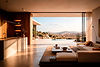
Furnishing without a project
does not lead to the desired result
Only the right balance makes it possible to create spaces
capable of preserving their value over time.
Beyond the images seen online.
Beyond temporary trends.
Interior design, supply and installation,
integrated into one cohesive investment
Interior design is the discipline that shapes the relationship between people and built space, with the aim of creating environments that improve function, perception and quality of life.
It is not just passion.
It is not improvisation.
It is not simply good taste.
It is a discipline that integrates technical, scientific, aesthetic and cultural principles: architecture, ergonomics, spatial physics, lighting design, perception psychology, function, proportions, acoustics, colour, form, material and product culture, and the history of art and design.
An interior design project is not about replicating a style
Looking at an image online or in a magazine and reproducing it in a different space does not guarantee the same result.
Architectural proportions, natural light, ceiling heights, depth, materials, orientation and the relationship between spaces completely change the final perception.
For this reason, a project cannot emerge from the mere reproduction of a style, but from the interpretation of the context in which it will exist.
Some aesthetic languages naturally enhance certain architectures, while others end up compromising coherence.
Just as a garment may appear perfect on display, yet fail to truly enhance the person wearing it.
An interior design project is also shaped by common sense
While evaluating the place and its context is essential to achieving a correct result, it is not enough on its own to achieve the best possible one.
The mere application of theoretical parameters does not automatically guarantee truly appropriate environments, especially when people’s everyday habits are overlooked.
The way spaces are actually used — how people move through them, work, relax, welcome guests or spend their time — profoundly influences every design decision.
But design common sense also means recognising when a specific request could compromise the quality of the final result.
Designing does not mean saying yes to everything. It means guiding the client towards more coherent solutions.
It is precisely within this balance between common sense and design responsibility that the true value of an interior design project is built.
An interior design project saves time and guides more conscious decisions
A two-dimensional floor plan makes it possible to understand layouts, dimensions and the technical functions of a space, yet without three-dimensional visualisations a project cannot truly be perceived in its entirety.
Renderings and visualisations make it possible to translate the project into understandable images, allowing the client to clearly see the outcome even before the purchasing phase begins.
This makes it possible to introduce changes during the design phase, avoiding mistakes, second thoughts and unnecessary costs once the execution has started.
The possibility of working with over 200 brands allows us to identify solutions aligned in terms of aesthetics, function and investment level, optimising the client’s budget and relieving them from the complexity of product research and selection.
Every proposal is built upon a carefully considered selection. Whenever necessary, alternative solutions are developed in order to offer freedom of choice without compromising the overall identity of the project.
An interior design project can also begin from choices that have already been made
Not every project starts from a completely empty home or from ideal conditions.
Clients often come to us with elements already purchased, materials already selected or spaces that have already been partially developed.
In other cases, they may wish to intervene in just one space, or to approach the project in phases over time.
This does not prevent the creation of a coherent result.
The role of the project is precisely to bring order to decisions, understand what deserves to be enhanced, and integrate every new element into a vision capable of maintaining balance and continuity.
Even when the starting point is shaped by choices made or developed at different moments in time, what truly makes the difference is the ability to transform separate elements into a meaningful whole.
And our design method does not change.
The project is an integral part of both the supply process and the overall investment
For us, the project is not a separate service, but the essential element that transforms a series of individual decisions into a truly successful whole.
For this reason, the design phase is not treated as an additional cost independent from the supply process, but as a phase integrated into the agreed overall investment.
An approach that allows us to develop every project as one coherent journey, from the initial concept through to the final installation.
The installation phase follows the same approach and is entrusted to qualified in-house personnel, ensuring execution to the highest professional standard.
To begin the design phase, an advance payment calculated on the agreed overall investment is required, subsequently incorporated into the supply process.
Should the project not proceed towards the final realization of the spaces, the amount paid will be considered compensation for the design service provided.
Design first. Then furnishing
We believe that the true value of a project does not lie in the simple selection of style and furnishings, but in the ability to create environments capable of genuinely reflecting the identity of the people who will live in them — beyond rules, standards and catalogue-like solutions.
For this reason, every project is developed as a bespoke process, where balance, listening and design responsibility become an integral part of the final result.
Linda Munaro — H&H Design